In short
- In May 2026, 30% of US employees used AI a few times a week or more, but only 25% said their organisation had a clear AI plan.
- Employees whose manager clearly supports AI use were 1.7 times as likely to use it often, and 7.4 times as likely to say it helps them do what they do best.
- Managers do not need to be AI experts. They need to go first, say what AI is for, and protect the time it saves.
Where AI use stands
Gallup tracks AI use among US employees every quarter. As of May 2026:
- 15% use AI in their role every day.
- 30% use it a few times a week or more.
- 52% use it at least a few times a year.
Source: Gallup AI in the workplace indicator, 2026
So roughly half the workforce has tried it, but only a minority uses it regularly. And the direction is unclear for most: only 25% of employees say their organisation has communicated a clear plan for integrating AI into how work is done. About three in four have no such plan.
The manager effect
In organisations that are bringing AI in, Gallup asked employees whether their manager actively supports their team's use of AI. Only 36% strongly agreed. But those who did were:
- 1.7 times as likely to use AI a few times a week or more,
- 7.4 times as likely to strongly agree that AI gives them more chances to do what they do best,
- 8.7 times as likely to strongly agree that AI has transformed how work gets done in their organisation.
Source: Gallup AI in the workplace indicator, 2026
These are associations, not proof that managers cause the difference. But they match decades of work psychology: people take their cues about what is safe and valued from their direct manager far more than from company announcements.
People take their cues from their manager, not from the memo.
Why it is the manager, not the memo
Trying a new tool in front of others carries a social risk. You might look slow, or like you are cutting corners. Amy Edmondson's research on psychological safety (1999) showed that teams learn when people feel safe to take interpersonal risks, and that the team leader shapes that feeling more than anyone. A manager who openly shares their own AI attempts, including the bad ones, makes trying it safe.
Self determination theory (Ryan and Deci, 2000) adds a second reason. People engage when they feel autonomy, competence and connection. AI rolled out as a mandate threatens autonomy. AI introduced as "here is time back for the work you care about" supports all three.
Try this tomorrow
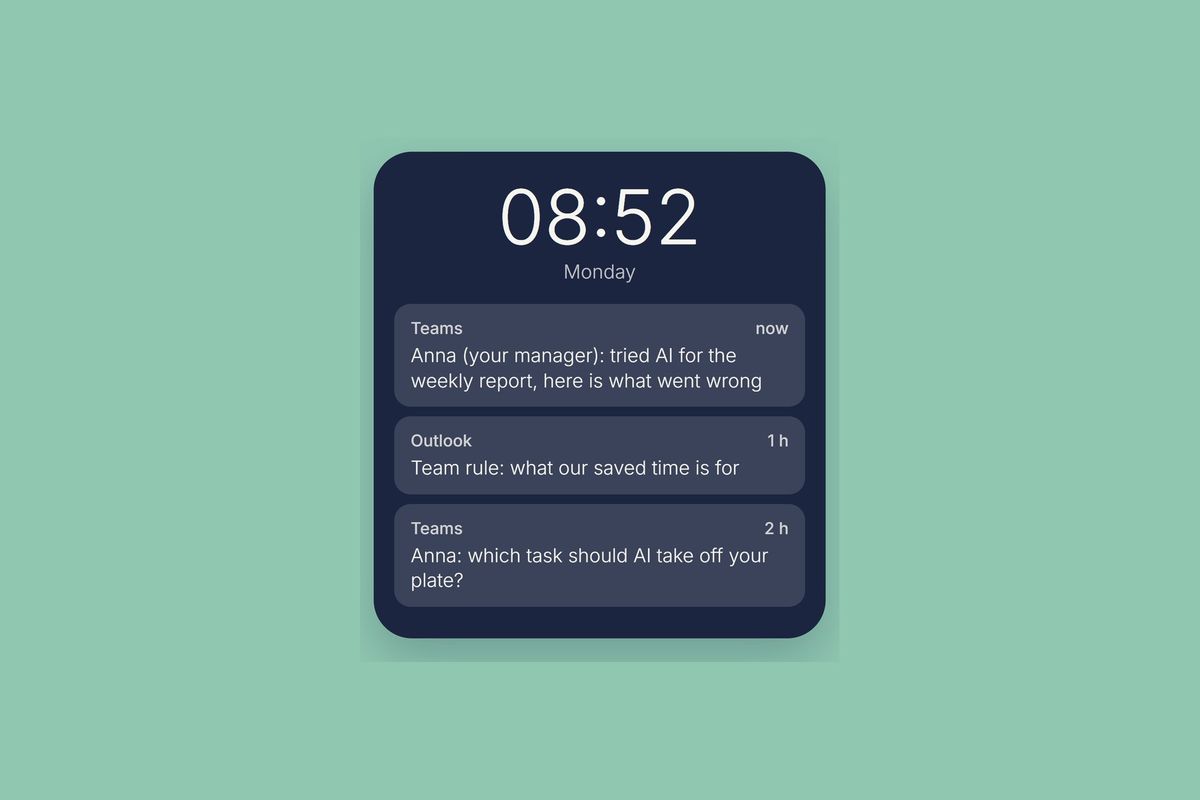
- Share one thing you used AI for this week in your next team meeting, including what went wrong.
- Say in one sentence what AI is for in your team, and what it is not for.
- Ask each person: which task would you most like AI to take off your plate? Then protect the time it frees.
Honest limits
Gallup's figures are for US employees and come from self reports. The manager effect is a correlation: teams with supportive managers may differ in other ways too. The psychology studies cited are classic and well replicated, but were not run on AI specifically.
Sources
- Gallup (2026). AI in the workplace indicator, data as of May 2026. source
- Edmondson, A. (1999). Psychological safety and learning behavior in work teams. Administrative Science Quarterly, 44(2), 350 to 383.
- Ryan, R. M., & Deci, E. L. (2000). Self determination theory and the facilitation of intrinsic motivation, social development, and well being. American Psychologist, 55(1), 68 to 78.