In short
- At Procter & Gamble, individuals with AI matched the performance of two person teams without AI, and felt better while working.
- At Boston Consulting Group, AI made consultants faster and better on most tasks, but 19 percentage points less likely to be right on a task it could not handle.
- The skill teams now need is knowing which side of that line a task is on.
Study 1: AI as a teammate at Procter & Gamble
In 2025, Fabrizio Dell'Acqua and colleagues from Harvard, Wharton and ESSEC ran a pre registered field experiment with 776 professionals at Procter & Gamble. People worked on real product innovation challenges. They were randomly assigned to work alone or in a pair, with or without AI.
Three results stand out:
- Performance. Individuals working with AI matched the performance of teams working without AI. AI replicated some of the benefits of human collaboration.
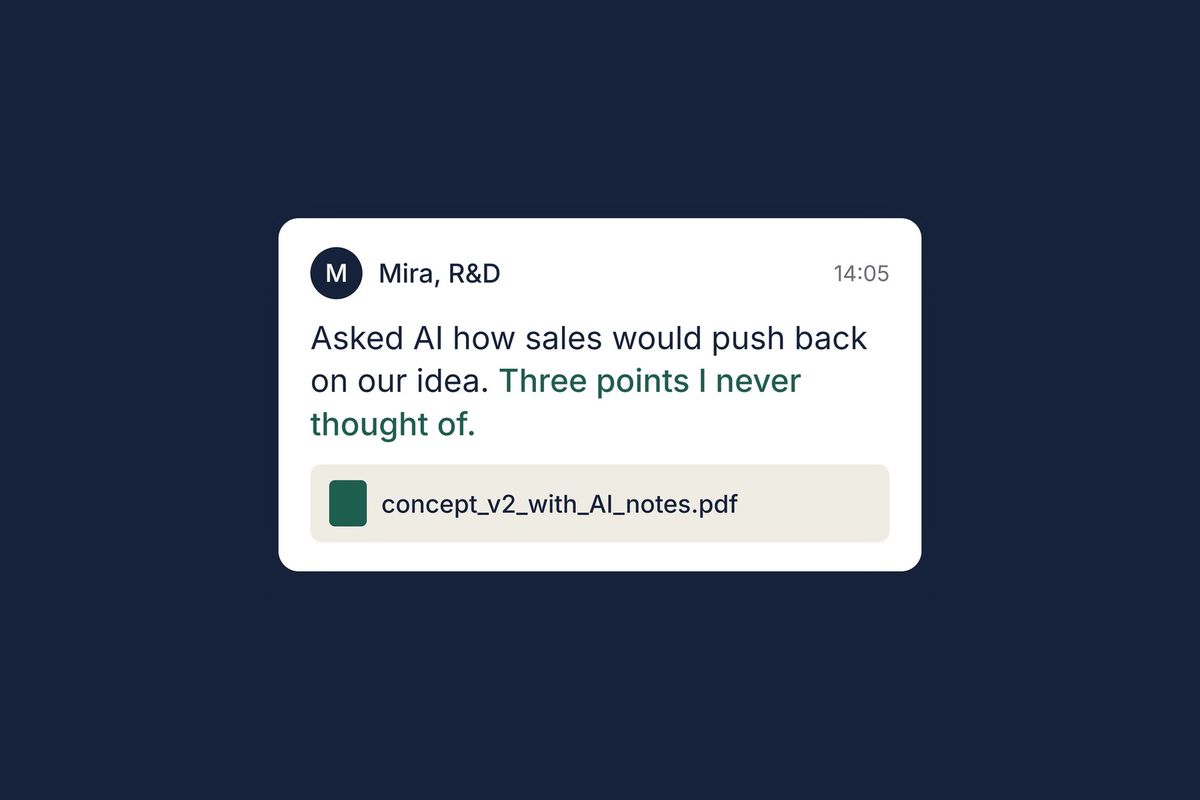
- Silos. Without AI, R&D people proposed more technical ideas and commercial people more commercial ones. With AI, ideas were balanced, whatever the person's background.
- Emotions. People working with AI reported more positive emotions. The authors suggest AI can partly fill the social and motivational role of a teammate.
Source: Dell'Acqua and colleagues, 2025
The authors call this the "cybernetic teammate". The study was published in Organization Science in 2026.
Study 2: the jagged frontier at Boston Consulting Group
An earlier experiment by many of the same researchers, run with 758 BCG consultants in 2023, shows the other side. On 18 realistic consulting tasks that AI could handle, consultants with GPT 4 did better on every measure:
Source: Dell'Acqua and colleagues, 2023
Source: Dell'Acqua and colleagues, 2023
Weaker performers gained most (43%), stronger ones less (17%). But on one task deliberately chosen to sit outside what AI could do well, consultants using AI were 19 percentage points less likely to get the right answer. The AI sounded just as confident, and people believed it.
Source: Dell'Acqua and colleagues, 2023
The researchers call this the jagged technological frontier: tasks that look equally hard can sit on different sides of what AI can do, and the line is invisible from the outside.
A human colleague says “I am not sure.” AI rarely does.
What this means for teams
Put together, the two studies say: AI can stand in for a colleague's input on many tasks, break down silos between functions and even make work feel less lonely. But it does not know where its own frontier is. A human colleague says "I am not sure". AI rarely does.
That shifts what good teamwork looks like. The valuable conversation is no longer "should we use AI?" but "is this task inside or outside the frontier, and who checks?"
Try this tomorrow
- For your next project, sort the tasks into three piles: AI first, human first, and human checks AI. Say the piles out loud in the kick off.
- When a task really matters, ask AI for its answer and then ask a colleague, not AI, to find the flaw.
- Keep the human pairings that build trust and learning, even when AI could replace the input.
Honest limits
Both studies were run with professionals from one large company each, on tasks chosen by the researchers, and with the AI models of their time. Today's models move the frontier, but research so far suggests it stays jagged. Positive emotions were self reported.
Sources
- Dell'Acqua, F., Ayoubi, C., Lifshitz, H., Sadun, R., Mollick, E., Mollick, L., Han, Y., Goldman, J., Nair, H., Taub, S., & Lakhani, K. (2025). The cybernetic teammate: a field experiment on generative AI reshaping teamwork and expertise. NBER Working Paper 33641. Published in Organization Science, 2026. source
- Dell'Acqua, F., McFowland III, E., Mollick, E., Lifshitz-Assaf, H., Kellogg, K. C., Rajendran, S., Krayer, L., Candelon, F., & Lakhani, K. R. (2023). Navigating the jagged technological frontier. Harvard Business School Working Paper 24-013. source