In short
- In a field experiment with 70,000 applicants, people interviewed by an AI voice agent were 12% more likely to get a job offer, with no drop in how productive the new hires were.
- The reason seems to be consistency: AI interviews were more structured, so recruiters got more useful information.
- In the EU, AI used for hiring is high risk under the AI Act. Emotion recognition at work is banned. The main hiring obligations now apply from 2 December 2027.
The experiment: humans or AI do the first interview
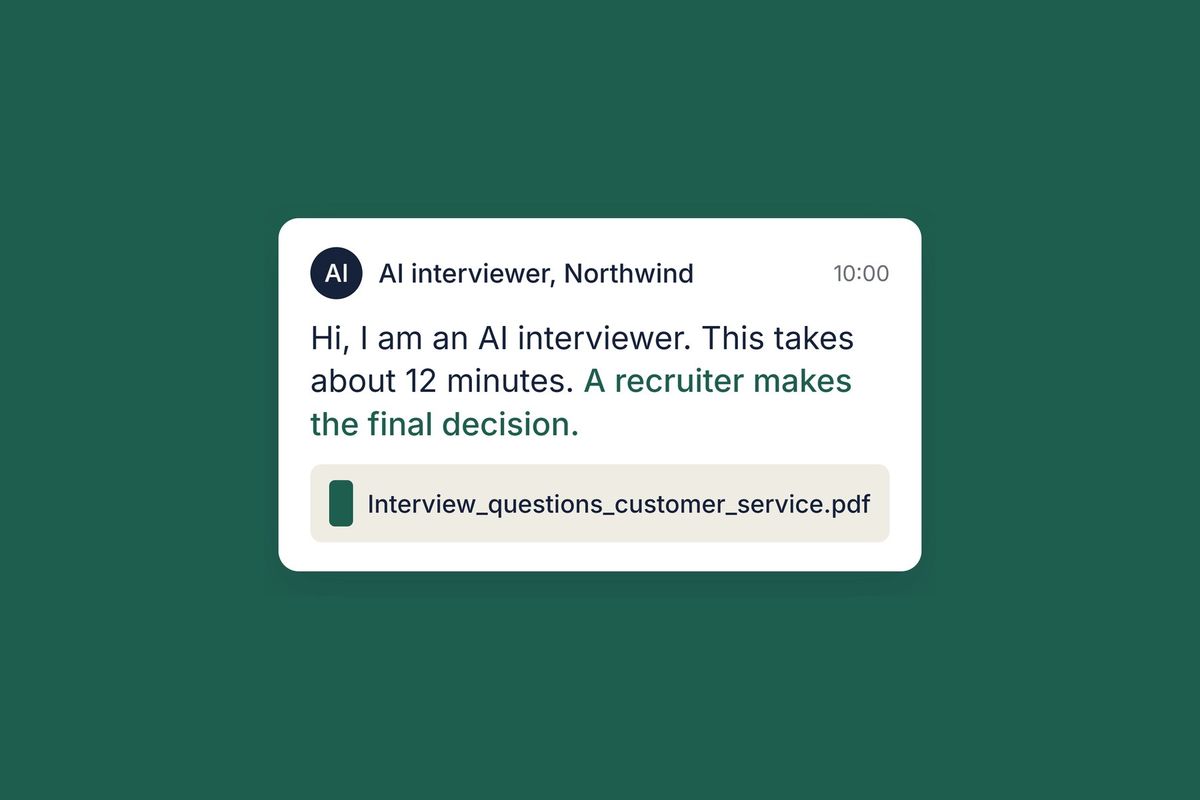
Economists Brian Jabarian and Luca Henkel worked with a recruitment firm on 70,000 applicants for real, mostly entry level jobs. Applicants were randomly interviewed either by a human recruiter or by an AI voice agent. In every case, a human recruiter read the interview and made the hiring decision.
Source: Jabarian and Henkel, 2025, updated 2026
Applicants interviewed by AI were 12% more likely to receive a job offer, which led to more people starting and staying in the job, with no decline in how productive the new hires were.
Why? When the researchers analysed the transcripts, the AI interviews were more structured and consistent, while still responding to each person. Every applicant got the same core questions, so recruiters had more comparable, hiring relevant information.
The psychology behind it
This is not new to work psychologists. For decades, research on selection, summarised by Schmidt and Hunter (1998), has shown that structured interviews, where everyone gets the same questions and is scored the same way, predict job performance better than free flowing conversations. Human interviewers drift: they chat more with people they like, and skip questions when they are tired. The AI did not drift. In that sense the result is less about AI being clever and more about AI being consistent.
The lesson for teams that are not ready for AI interviewers is simple: you can get much of the benefit by making your own interviews more structured.
Less about AI being clever. More about AI being consistent.
What European law now says
Under the EU AI Act, AI systems used in employment are classed as high risk. That covers systems used to recruit and select people, for example to filter applications or evaluate candidates, and systems used for decisions about promotion, termination, task allocation and performance monitoring.
- Already banned since 2 February 2025: AI that infers emotions of people in the workplace, except for medical or safety reasons. An interview tool that scores candidates' emotions from their face or voice falls under this.
- Moved to 2 December 2027: the main obligations for high risk employment AI, such as risk management, human oversight, logging and informing workers. The EU's Digital Omnibus on AI, Regulation (EU) 2026/1744, in force since 27 July 2026, moved this date from August 2026.
- Not repealed: the delay gives employers more time, but the obligations still come.
- 1 Aug 2024AI Act enters into force.
- 2 Feb 2025Ban applies: AI that infers emotions of people at work.
- 27 Jul 2026Digital Omnibus on AI in force, moving the high risk dates.
- 2 Aug 2026Original date for high risk employment AI. Moved.
- 2 Dec 2027New date: obligations for high risk AI in hiring and people decisions.
- 2 Aug 2028High risk AI built into regulated products.
Source: Regulation (EU) 2024/1689 as amended by Regulation (EU) 2026/1744
Watch: why a human check is not enough
A 10 minute video on what happens when people review an AI’s picks, with three real cases and five checks for your hiring tool.
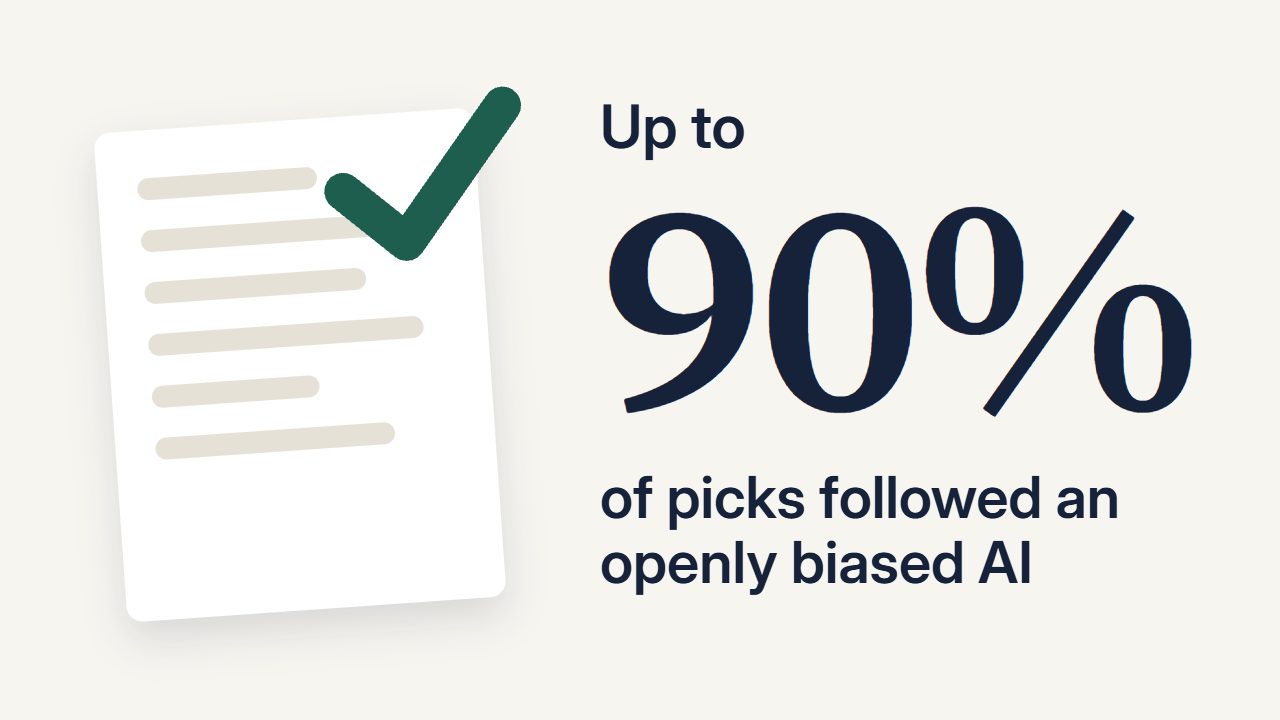
AI hiring bias: why a human check is not enough. Chapters, sources and five checks · Loads from YouTube only when you press play.
This is a summary for orientation, not legal advice. Check with your legal team before you buy or switch on an AI hiring tool.
Try this tomorrow
- Write down the five questions every candidate for your next role will get, and how you will score the answers, before the first interview.
- Ask any AI hiring vendor: does your tool infer emotions? Who makes the final decision? Can a candidate ask for a human?
- Tell candidates when AI is involved. In the experiment, the AI said it was an AI.
Honest limits
The experiment covered mostly entry level jobs through one recruitment firm, so results may differ for senior or specialist roles. The 12% is an average effect. The legal summary reflects the AI Act as amended in July 2026 and may change.
Sources
- Jabarian, B., & Henkel, L. (2025, updated 2026). Voice AI in firms: a natural field experiment on automated job interviews. CESifo Working Paper 12984. source
- Schmidt, F. L., & Hunter, J. E. (1998). The validity and utility of selection methods in personnel psychology. Psychological Bulletin, 124(2), 262 to 274.
- Regulation (EU) 2024/1689 (Artificial Intelligence Act), Article 5(1)(f) and Annex III, point 4. source
- Regulation (EU) 2026/1744 (Digital Omnibus on AI), amending the AI Act. In force 27 July 2026.
- Ius Laboris (2026). EU AI Act simplification: what the delays mean for employers. source