In short
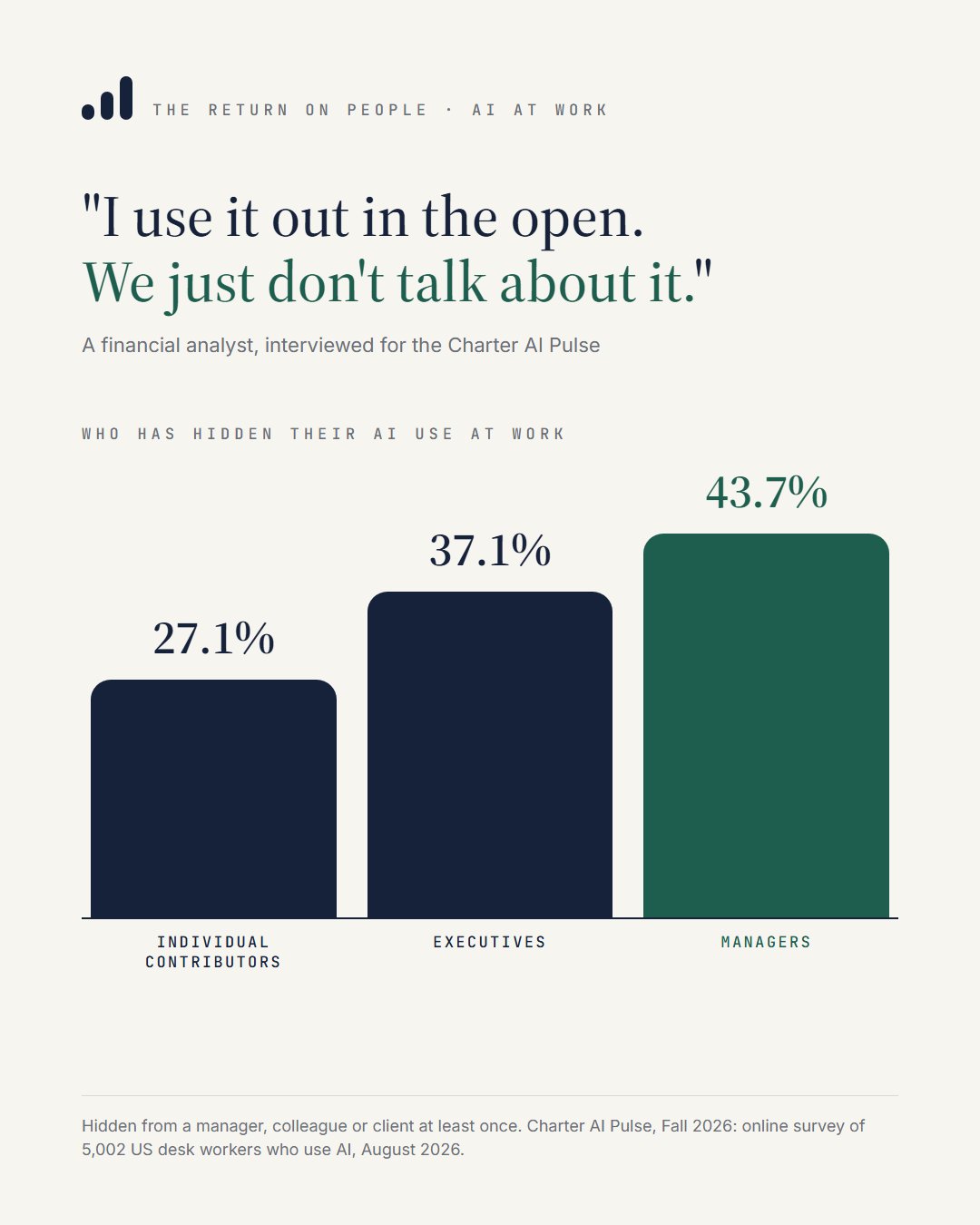
- In a survey of 5,002 US desk workers who use AI, 35.9% had hidden their AI use at least once. Among managers it was 43.7%.
- The fear has a basis: in experiments, people who used AI were judged as lazier, and people who disclosed it were trusted less.
- So the fix is a shared routine, not a confession: leaders go first, the rule fits in one sentence, and the first reaction is curiosity, not extra work.
The six findings
- Your managers hide it most. 43.7% of managers, 37.1% of executives and 27.1% of individual contributors have hidden their AI use from a manager, colleague or client. The most common worry, named by 49.3% of those who hid it: being seen as less capable. Charter AI Pulse, Fall 2026.
- Many people do not know the rules. In a 47 country study, 56% of employees had used AI at work without knowing whether it was allowed. Gillespie et al., University of Melbourne and KPMG, 2025.
- Bans go with more risky use, not less. 67% of employees whose organisation bans generative AI reported uploading company information or copyrighted material into public AI tools, against 33% where there was no such policy. A comparison, not an experiment. Gillespie et al., 2025.
- The penalty is real, but it depends on the task. In four preregistered experiments with 4,439 people, colleagues who used AI were rated as lazier and less competent. When AI clearly fit the task, the penalty on how well a candidate seemed to fit the job was offset. Reif, Larrick & Soll, PNAS, 2025.
- Being found out costs more than saying it. In 13 experiments with more than 5,000 participants, people who disclosed their AI use were trusted less, and trusted even less when someone else exposed it. Schilke & Reimann, 2025.
- The first reaction is read in seconds. According to the university's report on a survey of 604 daily AI users, employees could tell within the first thirty seconds whether their supervisor was supportive. Anicich & Brouwers, USC Marshall, 2026.
What is inside the guide
Each finding comes with its number, its honest limit and one thing to try tomorrow. Part 2 turns them into four tools you can use this week:
- A decoder for the first 30 seconds after someone tells you they used AI: what you say, what they may hear, what to say instead.
- The three line AI note to add to any report or deck where AI did real work.
- A 15 minute team meeting, minute by minute, with the manager going first.
- The manager mirror check: four lines to compare how you see yourself with how your team sees you.
The scripts are our practical reading of the research. They have not been tested as a whole in a study.
Try this tomorrow
- When someone tells you they used AI, start with "Show me how you did it" and "What did you check yourself?".
- Do not answer a shared AI method with extra work in the same conversation.
- Write your AI rule as one sentence a new starter could repeat.
Honest limits
These are surveys and experiments, mostly from the US. The surveys show links, not causes, and the experiments asked people to rate described colleagues, not real teams. The USC figures come from a university news report; no peer reviewed paper is named yet.
Sources
- Charter (2026). AI Pulse, Fall 2026. Released 21 October 2026.
- Gillespie, N., et al. (2025). Trust, attitudes and use of AI: A global study 2025. University of Melbourne and KPMG.
- Reif, J. A., Larrick, R. P., & Soll, J. B. (2025). Evidence of a social evaluation penalty for using AI. PNAS.
- Schilke, O., & Reimann, M. (2025). The transparency dilemma: How AI disclosure erodes trust. Organizational Behavior and Human Decision Processes, 188.
- Anicich, E., & Brouwers, S. (2026). USC Marshall School of Business news, 28 August 2026.